The pond had been shrinking for ninety-three days when Lena Hart finally saw the rope. Not the first six inches. Those had been visible for years. She saw all of it. Or at least enough to understand that the thing disappearing into the cracked mud was not what everyone had always assumed. Briar Creek Pond had once covered almost four acres at the southern edge of Lena’s farm. As a child, she had learned to swim there.
Her father taught her to cast a fishing line from the eastern bank. Her grandfather had built a narrow wooden dock that lasted until Lena was seventeen, when an ice storm finally tore it apart. The pond had watered cattle through hot summers, frozen solid enough for skating during hard winters, and reflected so many Kansas sunsets that Lena sometimes believed the sky itself belonged partly to the farm. Now it looked like a wound.
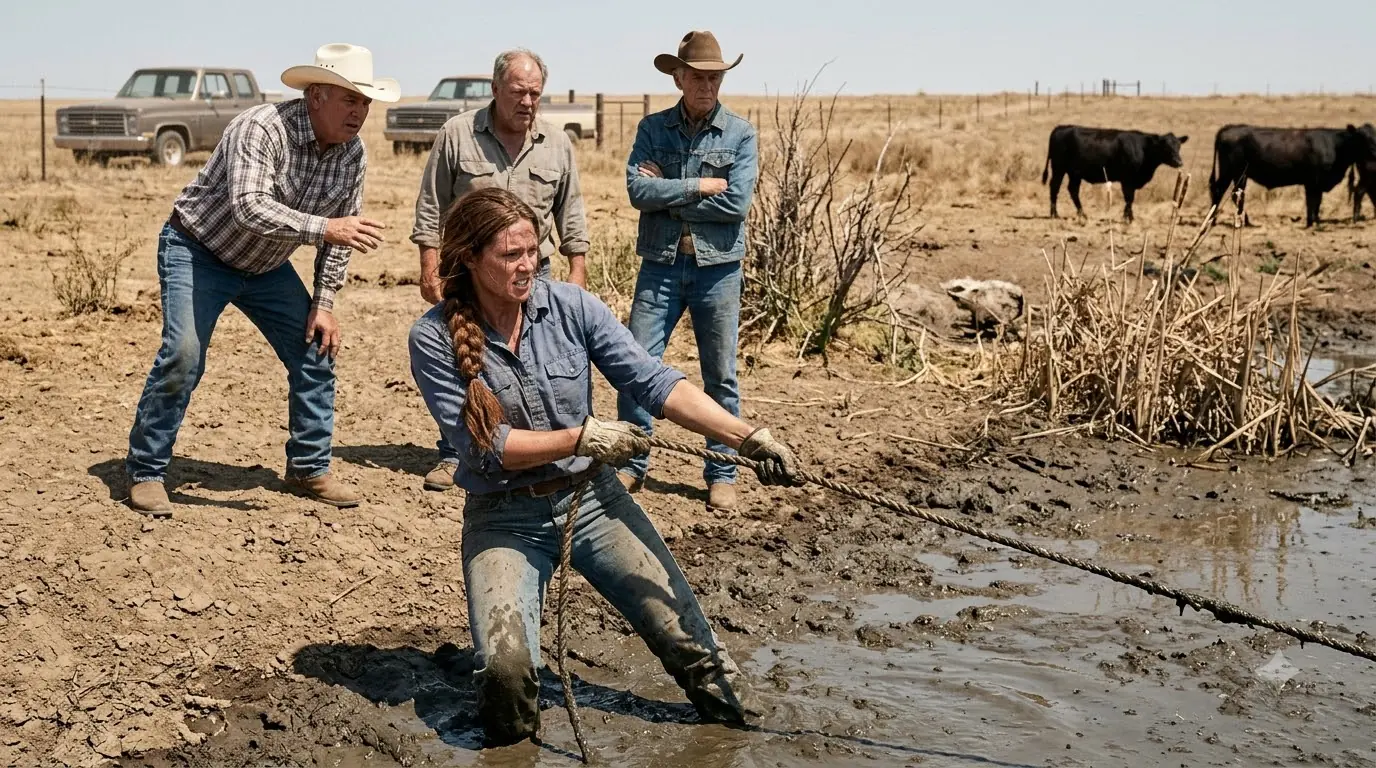
Mud occupied most of the basin. The remaining water was a brown oval barely deep enough for cattle to drink without stirring silt. The shoreline had retreated more than sixty yards. Dead reeds stood where water used to reach Lena’s waist. A cracked turtle shell lay beside one exposed stone. Lena stood on the bank with both hands resting on her hips. She was twenty-eight years old, five feet eight, lean and strong from years of lifting feed sacks, wrestling fence posts, repairing pumps, riding horses, and doing nearly every job people still liked to tell her required a man.
Her chestnut hair was tied into a thick braid. Dust darkened the knees of her jeans. A faded blue work shirt clung damply between her shoulder blades. The temperature had reached one hundred and four degrees before noon. There was no wind. That was the worst part. Wind at least made drought feel alive. Still heat made the land seem abandoned. Behind Lena, forty-three Angus cows moved slowly across a pasture that no longer deserved the name.
Grass had become brittle stems. The herd used to number seventy-six. She had sold twenty-seven in June. Six more would leave Friday. Every animal sold bought the farm another little piece of time. Diesel. Feed. Electricity. Interest. Time. Always time. Never enough of it. Her phone vibrated inside her back pocket. She ignored it. It vibrated again. Lena already knew who it was. First Plains Agricultural Bank. They had called three times that week. Thirty days.
That was what the letter said. Thirty days to bring the operating note current. Thirty days before the bank began what its language politely called “asset recovery procedures.” Foreclosure. Lena hated vocabulary created to make disaster sound administrative. She crouched at the water’s edge. The rope lay fifteen feet away across sticky mud. She had noticed it before. Everyone had. A thick, weather-darkened rope, half buried near what used to be the deepest part of the pond.