When Isaiah Bennett lifted his violin beneath the white lights of the faculty room, twelve teachers watched as though they had been asked to judge a mistake somebody else had made.
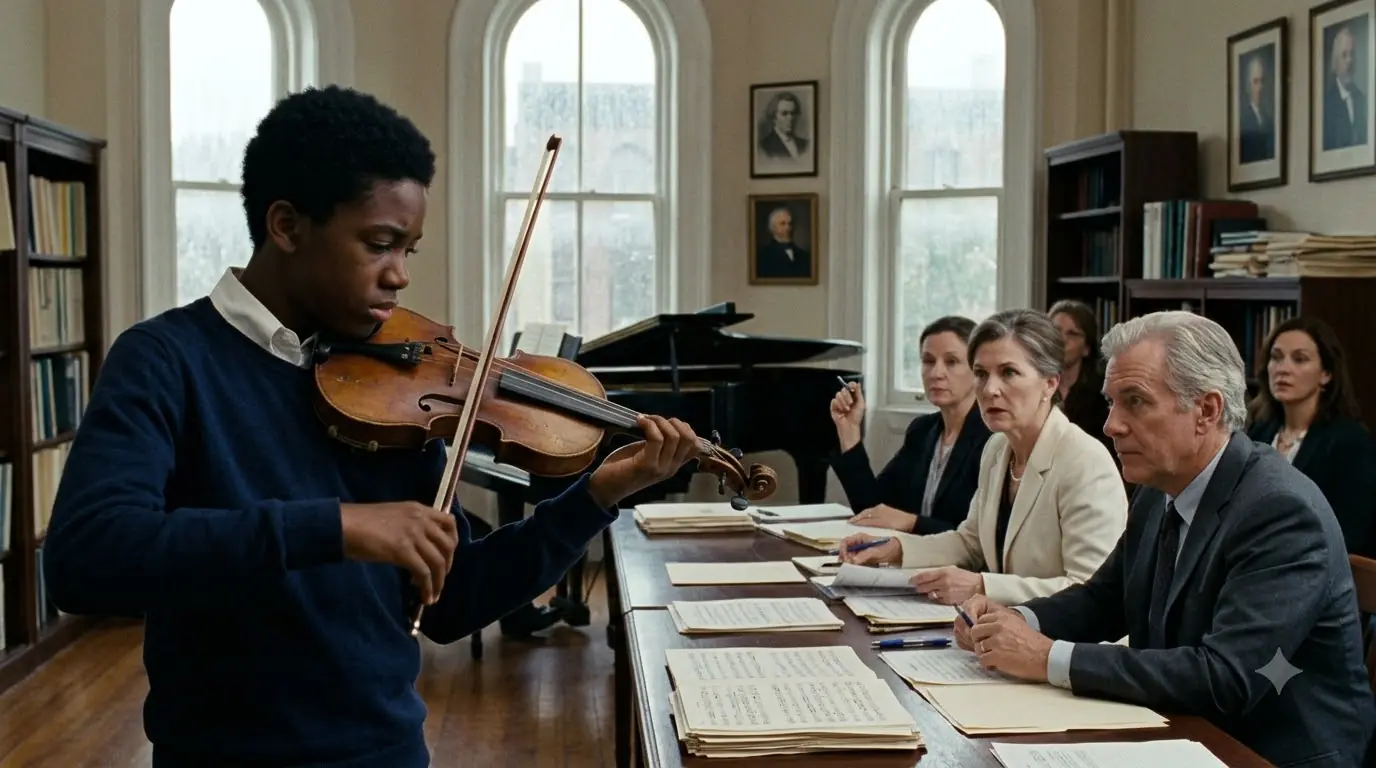
He was fourteen, small for his age, with narrow shoulders and a dark blue sweater whose elbows had begun to shine from wear. The violin rested beneath his chin, its varnish rubbed pale near the neck, its bridge a shade darker than the wood around it. His mother had spent the previous evening cleaning the cuffs of his shirt and pressing the collar between two folded towels because their apartment iron had stopped working. None of those details belonged on an evaluation form, yet Isaiah knew that in a building where families arrived carrying instrument cases worth more than his mother's car, every visible detail could become an opinion before he played a note.
The room at Crescent Academy of Music in Philadelphia had once been a library. Dark wooden shelving lined the walls, now occupied by scores, busts of composers, and trophies from competitions held long before Isaiah was born. The grand piano in the corner gleamed like black water. Rain ticked against tall windows. At the far end of the room, Professor Charles Whitaker sat with his hands folded over a yellow legal pad, while the academy's artistic director, Dr. Margaret Ellery, studied the program with an expression that suggested scheduling had inconvenienced her.
Isaiah could hear the whispers even though the teachers probably believed he could not.
"A community scholarship?" someone murmured. "I wasn't aware he was ready for a full faculty review."
Another voice replied, "Whitaker insisted. He hears things in these neighborhood students."
The word neighborhood had become familiar to Isaiah in his first six weeks at Crescent. He had learned that people could say it gently and still make it sound like a locked gate. He came from the western side of the city, where buses ran late, the corner grocery sold single rolls of toilet paper, and children learned early which streets to avoid after dark. To many of the academy's families, the neighborhood appeared mainly in fundraising brochures beside phrases about untapped potential. Isaiah lived there. He knew which landlord had ignored the leaking ceiling in his aunt's kitchen and which bakery owner saved yesterday's bread for people who needed it. The difference between representation and residence was something he felt before he knew how to name it.
"Whenever you're ready," Dr. Ellery said.
He had been ready in his bedroom at five that morning, when the heat made a hollow knocking sound and his younger sister was still asleep on the pullout couch. He had been ready on the bus when he silently rehearsed every shift in the first movement of the piece. But now his left hand felt unfamiliar, as if the fingers belonged to a boy who had only learned to hold the instrument that week. He drew one careful breath and remembered something his grandfather used to tell him before every church performance: The first note isn't asking anybody's permission. It's telling you where home is.